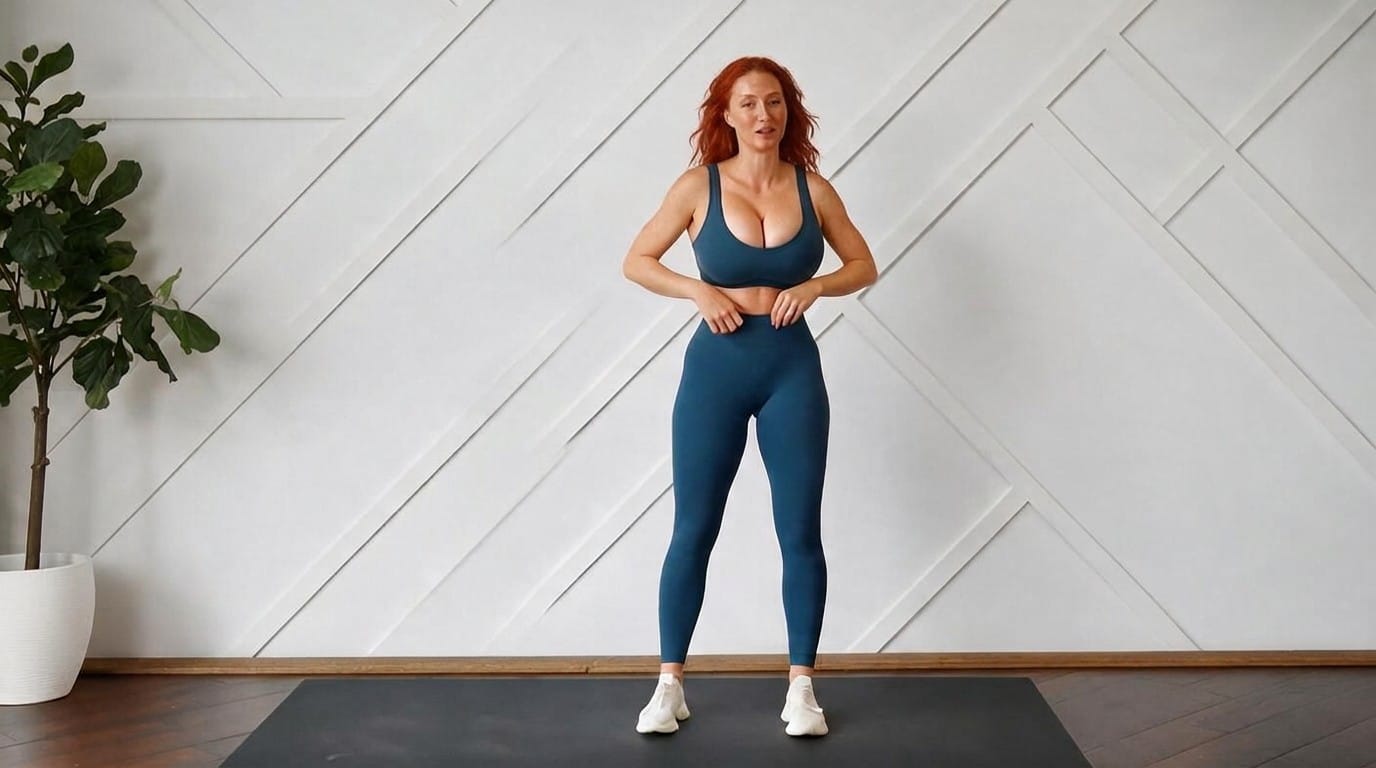
Building lean muscle and developing functional strength in your 20s, 30s, and 40s requires progressive tension and smart movement patterns. Discover five foundational resistance exercises you can perform at home to stimulate muscle hypertrophy, elevate metabolic rate, and build lifelong joint resiliency—from compound goblet squats to posterior chain Romanian deadlifts.
- Focus: Strength Gains & Muscle Hypertrophy
- Women (Ages 25–50)
5 Essential Strength Exercises for Home Workouts
Gaining functional strength and sculpting lean muscle requires progressive resistance, consistency, and proper movement execution. For women between ages 25 and 50, strength training is the single most effective tool to combat natural age-related muscle loss (sarcopenia), maintain optimal metabolic health, and safeguard bone mineral density. For seniors, read this at-home recover exercises.
Controlled, multi-joint resistance exercises signal muscle fibers to adapt and grow while reinforcing core stability. Whether you are using dumbbells, resistance bands, or starting with bodyweight progressions, mastering these foundational movement patterns ensures balanced, full-body development.
The 5 Strength Movements
- Goblet Squats
- Dumbbell Romanian Deadlifts (RDLs)
- Standard or Incline Push-Ups
- Dumbbell Single-Arm Bent-Over Rows
- Glute Bridges (Weighted or Single-Leg)
Goblet Squats
- Focus Area: Quadriceps, glutes, adductors, and anterior core.
- Best For: Lower-body hypertrophy, upright posture reinforcement, and hip mobility.
- Authority Reference: NASM Goblet Squat Guide
Goblet squats are a premier lower-body builder. Holding a single dumbbell or kettlebell vertically against your chest naturally enforces an upright torso, reducing spinal shear stress while allowing for deep hip flexion.
How to do it: Stand with your feet slightly wider than shoulder-width, toes turned out 15 to 30 degrees. Hold your weight tight against your sternum. Inhale, brace your core, and push your hips back and down as if sitting into a low chair. Drive your knees out in line with your toes until your thighs reach parallel to the floor. Drive through your mid-foot and heel to stand tall, squeezing your glutes at the top. Aim for 3 to 4 sets of 8–12 repetitions.
Dumbbell Romanian Deadlifts (RDLs)
- Focus Area: Hamstrings, gluteus maximus, and spinal erectors.
- Best For: Posterior chain strength, lifting mechanics, and sculpting the back of the legs.
- Authority Reference: ACE Fitness Romanian Deadlift Technique
The Romanian Deadlift is an essential hip-hinge pattern that loads the posterior chain under a deep muscular stretch, which is one of the strongest drivers of muscle hypertrophy.
How to do it: Stand tall holding a pair of dumbbells in front of your thighs, feet hip-width apart with a soft bend in the knees. Keeping your shoulder blades retracted and back flat, push your hips directly behind you as if trying to touch the wall behind you. Slide the weights along your shins, descending only until you feel a deep stretch in your hamstrings (usually just below the kneecap). Drive your hips forward to return to standing, locking out with your glutes. Aim for 3 sets of 10–12 controlled reps.
Standard or Incline Push-Ups
- Focus Area: Pectoralis major, anterior deltoids, triceps, and transverse abdominis.
- Best For: Upper-body horizontal pushing strength and anti-extension core control.
- Authority Reference: NASM Push-Up Mechanics Guide
Push-ups remain one of the most effective upper-body compounds available. They develop upper-body pressing mass while challenging the deep core to maintain a rigid plank throughout the movement.
How to do it
- Place your hands slightly wider than shoulder-width on the floor (or elevate your hands on a sturdy bench or countertop to scale the resistance).
- Form a rigid line from heels to head. Lower your chest with control until it hovers an inch above the surface, keeping your elbows tracking back at a 45-degree angle rather than flared wide.
- Press firmly through your palms to return to the starting position. Aim for 3 sets of 6–10 clean reps.
Dumbbell Single-Arm Bent-Over Rows
- Focus Area: Latissimus dorsi, rhomboids, rear deltoids, and biceps.
- Best For: Upper-back muscle density, balanced shoulder posture, and pulling power.
- Authority Reference: ACE Fitness Single-Arm Row Exercise Guide
Single-arm rows allow you to train each side of your back independently, correcting muscular asymmetries while supporting the spine with a stable, braced position.
How to do it: Place your left knee and left hand firmly on a sturdy bench or chair, keeping your spine neutral and torso roughly parallel to the floor. Hold a dumbbell in your right hand with your arm extended. Retract your right shoulder blade and pull your elbow upward and backward toward your hip, keeping the dumbbell close to your side. Pause at peak contraction, then lower the dumbbell smoothly under control. Complete 3 sets of 10–12 reps per side.
Glute Bridges (Weighted or Single-Leg)
- Focus Area: Gluteus maximus, hamstrings, and pelvic floor stabilizers.
- Best For: Direct glute hypertrophy without spinal loading, counteracting prolonged sitting.
- Authority Reference: ACE Fitness Bent-Over Row & Posterior Chain Movement Guide
The glute bridge allows you to maximally isolate and contract the glutes at short muscle lengths without placing any compression on the lower back.
How to do it:
Lie flat on your back with your knees bent and feet planted flat on the floor, about hip-width apart and roughly 6–8 inches from your glutes. Rest a moderate dumbbell across your hip crease (holding it secure with your hands) or perform it bodyweight-only. Drive through your heels to elevate your hips toward the ceiling until your knees, hips, and shoulders form a straight line. Squeeze your glutes hard at the top for 2 seconds before lowering under control. Aim for 3 to 4 sets of 12–15 reps.
Take Your Strength Further with Kyle Hansen Fitness
Consistent strength training doesn’t require hours in a commercial gym or complex machinery. By applying progressive overload—gradually adding weight, repetitions, or slowing down your tempo—these five movements create a comprehensive foundation for building lean muscle, protecting joint integrity, and boosting daily energy.


